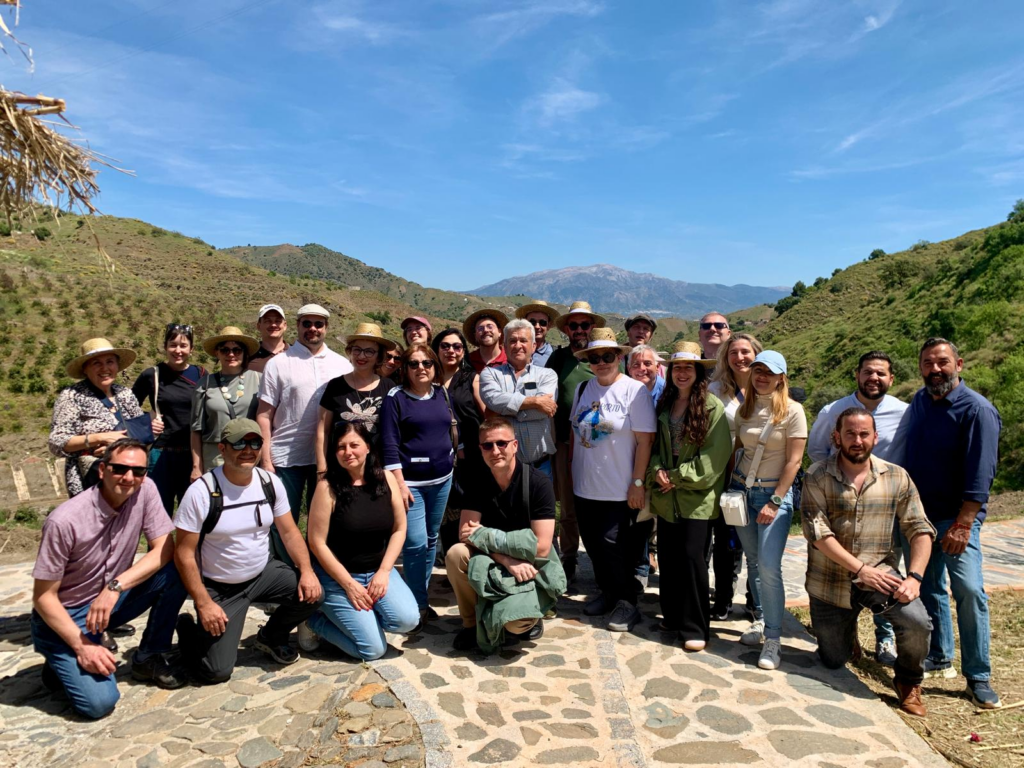

This article is based on a presentation about Málaga raisins held for MARGISTAR members at the Galería del Bandolero Interpretation Center by the Almáchar cooperative. Thank you, Maria Martín Fernández and Carolin Zobel, for your insightful introduction!
The Axarquía region of Málaga is one of contradictions. To the tourist, it is a rugged viticulture paradise. To the local farmer, it is a demanding landscape that often asks for more than it gives back. Behind the world-renowned Muscat of Alexandria raisin lies a story of a community fighting to remain rooted in the land while the globalised world moves on.
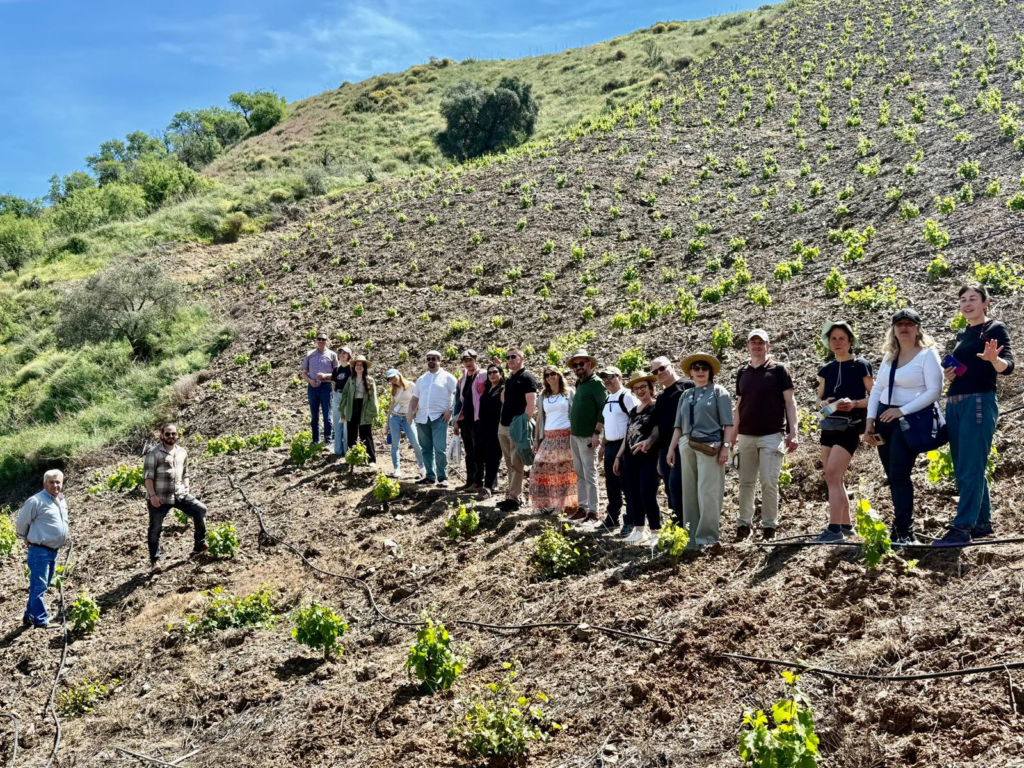
Welcome to Axarquía
The Axarquía region, located to the east of Málaga, comprises 31 municipalities known for their mountainous landscapes and picturesque white villages of Arab origin.
The region is organised into five distinct cultural and gastronomic routes, each with its own special charm:
- The Raisin Route: Including El Borge, Almáchar, and Moclinejo.
- The Mudejar Route: Showcasing the region’s deep Arabic architectural roots (Arenas, Salares).
- The Sun and Avocado Route: Highlighting the shift toward subtropical crops in the valley floors from Rincon de la Victoria to Benamargosa.
- The Olive Oil and Mountain Route: Home to the Verdial and Picual olives.
- The Sun and Wine Route: Famous for the sweet wines of Competa and the coastal charm of Nerja.
On April 19, 2018, in Rome, Málaga raisins from the Axarquia region were recognised by the Food and Agriculture Organisation (FAO) of the United Nations as a Globally Important Agricultural Heritage System (GIAHS), becoming the first in Europe.
The Economic Paradox: €9 vs. €24
Despite these popular walkways and landscapes, the region is also heavily impacted by marginalisation on multiple fronts. In villages such as Almáchar and El Borge, a way of life linked to vine growing has been passed down for generations, although it requires heavy work due to the region’s terrain.
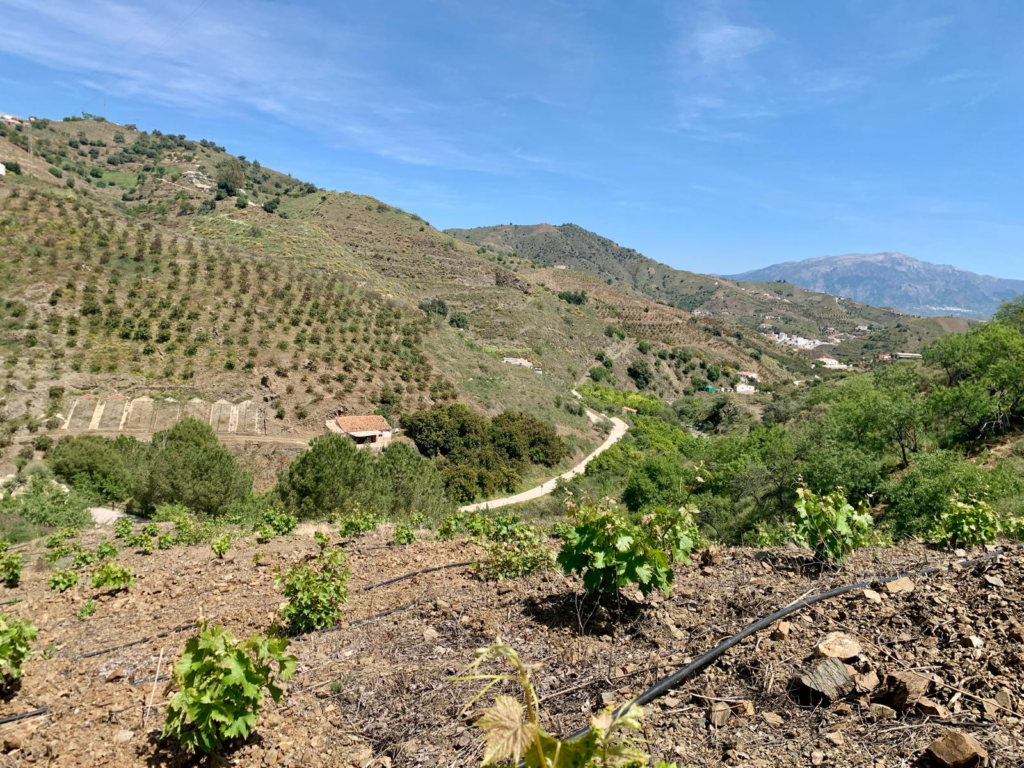
This is particularly visible in the area’s the price-value gap: a farmer in El Borge or Almáchar spends a year tending to vines on steep slopes, harvesting by hand, drying the fruit in the sun, and sorting raisins late into the night. For this extra-grade artisanal product, the farmer receives roughly €9 per kilo. Yet, just 40 kilometers away at the Atarazanas Market in Málaga city, that same kilo is sold for €23 or €24.
This disparity is an example of commodity marginalisation. Middlemen and high-end retailers capture the majority of the profit, while the primary producer – the one bearing the physical and financial risk – remains in a state of working poverty. When farming alone cannot sustain a family, it ceases to be a profession and becomes a costly sacrifice.
The Invisible Labourer: The Double Life of the Farmer
Farming the Axarquia region reveals a poignant truth about rural life in Málaga: the vineyard is rarely a sole source of income. The testimony of families in Almáchar describes a grueling double life in which weekdays are spent working in construction or the seasonal sugar cane harvest, while Saturdays and Sundays are spent in the fields. At night, returning from a day of manual labor in the city, some families report continuing to work in order to sort and prepare the raisins.
This necessity for dual employment highlights the lack of institutional and structural support for small-scale heritage farming. Despite the FAO’s “Globally Important” label, there remains a lack of direct subsidies or price protections that would allow a farmer to focus solely on their craft.
The “Green Gold” Invasion and the Water Crisis
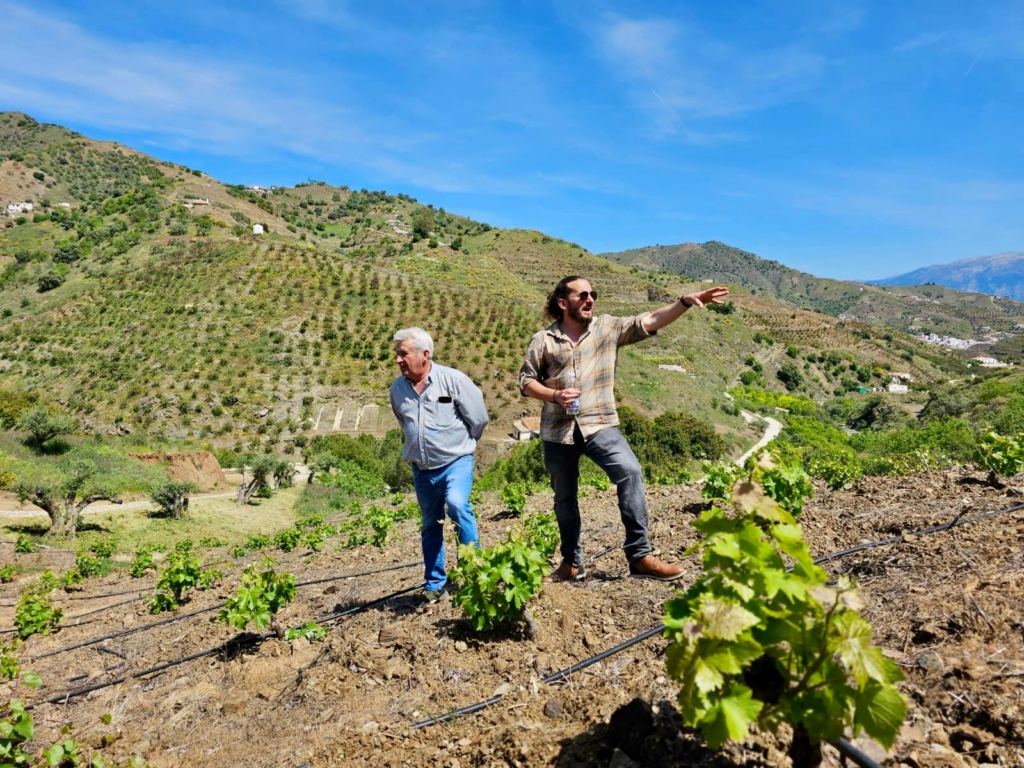
In addition, a new challenge is physically changing the face of the Axarquía: the pivot to subtropical crops like avocados and mangoes.
Driven by global demand and the promise of less labor-intensive work, many farmers are abandoning the vine for “green gold.” However, this shift brings its own form of marginalisation, as mangoes and avocados are incredibly thirsty crops.
In a region currently facing its worst drought in decades, the diversion of water to these plantations leaves traditional dry-land crops, like the ancient Muscat vines, even more vulnerable.
The abandonment of the vine doesn’t just change the economy; it changes the landscape’s safety. As history showed after the 1878 Phylloxera plague, when the vines were lost, the mountains lost their stability, leading to catastrophic flooding. The vine is the “skin” of the Axarquía and without it, the land itself begins to slide.
Generational Flight
Perhaps the most personal challenge is the region’s lack of generational renewal (“falta de relevo generacional”). When the youth leave for the city, they don’t just take their labor; they take century-old knowledge of how to prune a vine. This is a form of cultural marginalisation in which the rural world is emptied, leaving behind an aging population to defend a heritage that the modern market refuses to pay fairly for.
The FAO (GIAHS) recognition was intended to trigger tourism and higher prices, but for many families, the benefits haven’t trickled down. For the Axarquía to survive, the conversation must move beyond tradition and toward social justice through, for example, fair trade initiatives, better irrigation infrastructure that prioritises heritage crops, and educational incentives that treat viticulture as a specialized technical craft, encouraging young people to see a future in the land.
A Call to the Consumer
As a visitor or a consumer, the best way to combat the marginalisation of the Axarquía is through conscious purchasing. When you visit the festivals in September – the Día de la Pasa in El Borge or the Ajoblanco Festival in Almáchar – buy directly from the producers. Supporting the Muscat of Alexandria is a testament to human resilience against a difficult terrain and an act of resistance against the disappearance of a 3,000-year-old way of life.