

Rajesh Nautiyal, Lecturer, University of Lincoln, UK
What do a Himalayan wood stove and a Finnish campfire have in common? Reflecting on childhood evenings spent around a fire with family in the Himalayas and a memorable gathering during the MARGISTAR Training School in Finland, Rajesh explores how fire has long served as a catalyst for human connection. From storytelling and shared meals to informal conversations and new friendships, the experience of making traditional Finnish lettu around a fire in a Sami-style Kota revealed how simple elements can bring people together across cultures.
I wonder at times how fire is not merely present in human life but is in fact an essential element shaping it, socially, culturally, and psychologically. Growing up, sitting beside the wood fire stove in the Himalayas with my mother and grandmother nearby, I was not just listening to stories; I was participating in a deeply rooted human practice. Around that fire, stories were told, memories were preserved, and intergenerational knowledge was transmitted. At times, my grandmother’s friends, companions, and relatives would gather. The fire did not simply provide warmth, it created a space where people lingered, interacted, and connected. Sometimes I laughed, sometimes I observed quietly, trying to make sense of the dynamics unfolding in that shared space in my little brain, which used to think that the whole world was just between the mountains where I used to reside.
Looking back, those moments suggest that fire functioned as more than a physical necessity, it acted as a social anchor. Since then, whenever I encounter a fire, I instinctively associate it with social bonding. This association is not accidental but seems to emerge from repeated lived experiences, where, fire structured human interaction.
One such incident, now firmly placed among my most good memories, is my trip to Finland for the MARGISTAR Training School at Rokua. While the academic components, the conceptual discussions, and exchanges, were undoubtedly valuable, what left a deeper imprint was an experience that moved beyond this structured learning. The hosts invited us, participants from different countries, different cultural backgrounds, and different research interests into an informal shared setting. In retrospect, this invitation can be seen as an intentional or perhaps intuitive creation of a social environment designed to foster connection.
In the evening, we were guided to a hut called a Kota near a frozen lake. I had initially missed this detail, perhaps due to the distraction of my wandering mind, but was later reminded by another participant via WhatsApp and came to understand it better during dinner conversations.
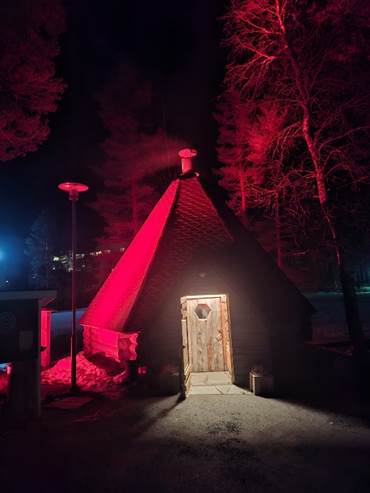
After dinner, we proceeded together to Kota: a wooden enclosure with a central open fire space, later identified to me as an arina/ahjo. This architectural arrangement is significant. By design, it positions fire at the centre, both physically and socially, ensuring that all participants orient themselves around it differently from what I used to have in my village. Such spatial arrangement here implicitly encouraged visibility, interaction, and collective attention.
When the fire was lit, it marked the activation of the space. Soon after, food was introduced, traditional Finnish pancakes called lettu. Here, two fundamental elements, fire and food, began to operate somehow together. Using fire as a foundational act of human connection, we created Finnish pancakes together, everyone participating, everyone contributing. This act transformed participants from passive attendees into active contributors, which itself required coordination, patience, and shared attention.
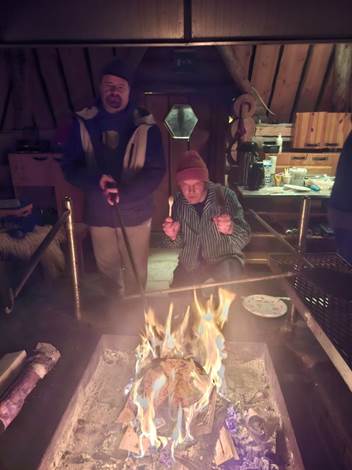
The utensils, a pan with an extended handle, along with the seemingly simple cooking method, butter followed by batter, added another layer of engagement. While the process appeared straightforward, its execution with an extra-long handle revealed complexity, especially for those unfamiliar with it, like me. Participants began experimenting, guided by the hosts, who offered feedback. This dynamic introduced an element of learning through doing, where minor successes and mistakes became shared experiences rather than individual ones and were often accompanied by laughter.
As the activity unfolded, a noticeable shift occurred in social behaviour. People who may have initially been reserved began engaging more openly. Conversations emerged organically, moving beyond formal introductions. Sitting near the entrance, I observed how the circular seating arrangement, facing the central fire, enabled constant visual contact. This configuration reduced social barriers, making it easier to initiate and sustain interaction. I moved between groups, engaging in conversations, gradually building connections, even extending them digitally through platforms like LinkedIn.
Simultaneously, the act of cooking and sharing lettu reinforced a sense of collective participation. The fire’s warmth extended beyond physical comfort; it appeared to influence emotional openness. Laughter became more frequent, and encouragement became a recurring pattern. Participants supported each other in small yet meaningful ways, guiding, waiting, appreciating. These micro-interactions contributed to a larger atmosphere of trust and ease.
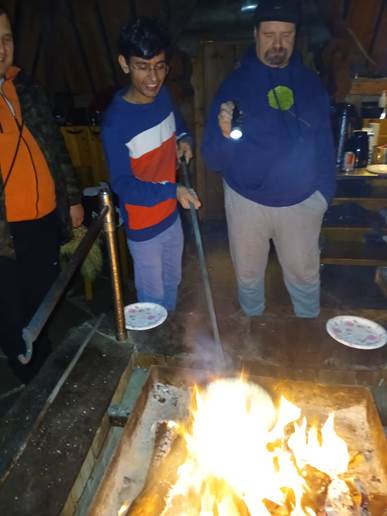
I began documenting these moments through photographs (with permission), recognising them as instances where social boundaries were dissolving. As discussions deepened, ranging from research interests to personal hobbies, participants physically repositioned themselves, moving closer to others, forming new conversational clusters.
At this point, a question emerged: “Was this experience intentionally designed as an ice-breaking exercise, or was it an organic outcome of the setting?” The location, a hut beside a frozen lake, the presence of fire, and the shared preparation of food could all be interpreted as deliberate choices. I did not ask the host and did not have an intention to do so, as sometimes not knowing is fun! However, it is equally plausible that such settings naturally evoke human tendencies toward connection.
To process these thoughts and to refresh myself a bit, I stepped outside of the Kota. The contrast was striking: a quite night, tall pine trees, a vast sky with scattered clouds, and the visible Orion constellation, I guess that was the only constellation I could identify at that time. Turning back toward the hut, I saw a simple structure containing what could be considered foundational elements of early human life: fire, shelter, and food.
Upon re-entering, the smell of smoke immediately triggered memories of my childhood. This sensory connection reinforced the idea that fire operates not only in the present but also as a bridge to past experiences. In that moment, I felt positioned within a continuum, linking early personal memories with current social interactions.
While this experience can certainly be appreciated as an excellent example of Finnish hospitality by Simo and Mikko teaching and guiding us on making the lettu, and academic exchanges with Eva and Juha, it also reveals a broader pattern. Fire, when combined with food and a secure environment, appears to activate deeply embedded human behaviours. It encourages proximity, lowers social defences, and facilitates communication. This suggests that humans may indeed be predisposed, perhaps even biologically wired, to connect under such conditions.
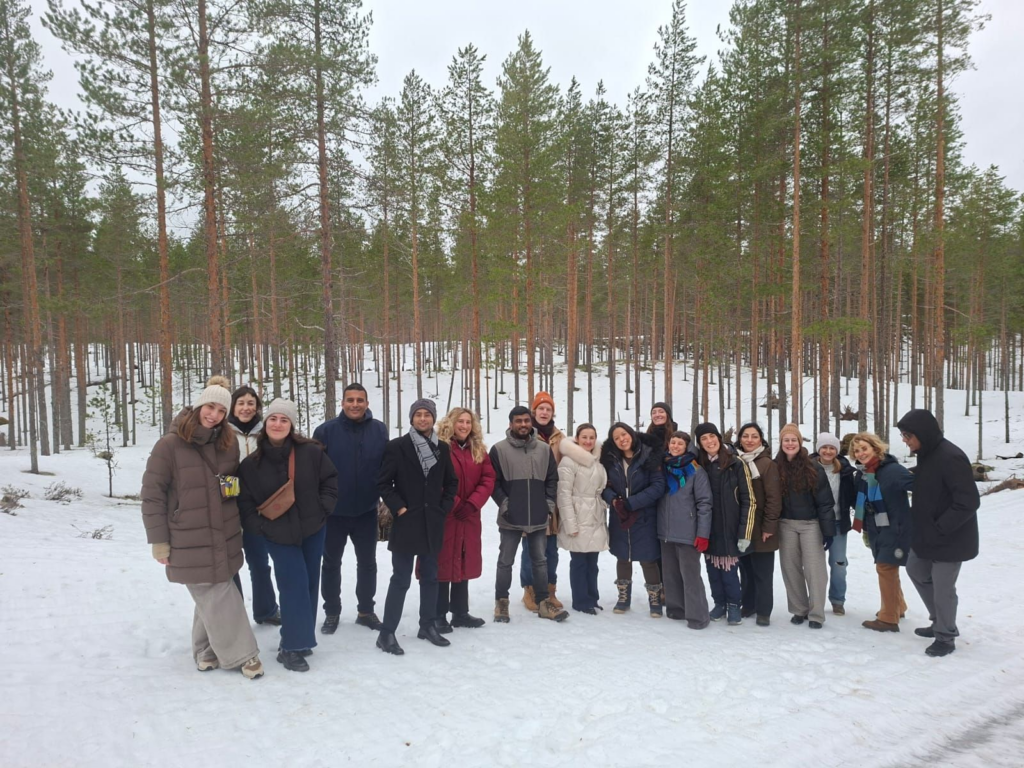
While writing a post for LinkedIn in my room, thinking that what I experienced was not just a pleasant evening, but a demonstration of how elemental forces, particularly fire, continue to shape human interaction, of course, with a flavour of Finnish hospitality due to my unexpected selection for MARGISTAR training school!