

MARGISTAR at the Sustainability of COST Actions Networking Event in Brussels

Date:

Share post:

Written by Andrej Ficko (University of Ljubljana, Biotechnical faculty)

Trust, Ideas, and Proof of Concept: Key Elements for Sustaining the COST Action Network

The COST Academy – Sustainability of COST Actions Networking Event, held on February 17 in Brussels, brought together researchers and network leaders to explore strategies for ensuring the long-term sustainability of COST Actions. Organised by the COST Association, the event gathered experts from diverse scientific domains to share insights on maintaining collaboration and impact beyond the funded project period. Our vice-chair Prof. Andrej Ficko represented MARGISTAR at the event.

After the opening remarks, participants engaged in small-group discussions, exchanging ideas on ongoing and planned activities aimed at sustaining COST networks. Key speakers included representatives from Ocean4Biotech, Clear Climate, the European Burden of Disease Network, and the BAANG Twinning project. They shared their experiences in securing funding, sustaining networks, and continuing scientific contributions in fields such as marine biotechnology, climate information services, disease monitoring, and aviation energy harvesting.
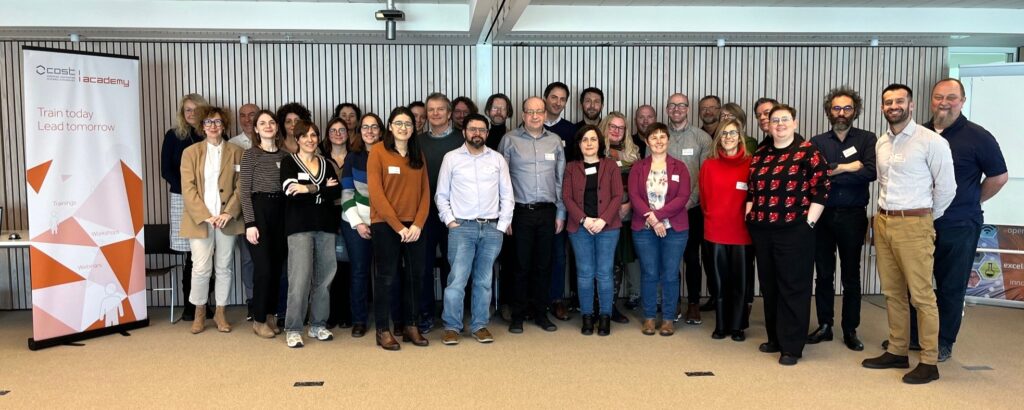
Group Photo at the COST Academy - Sustainability of COST Actions Networking Event

Training Today – Leading Tomorrow

A panel discussion followed, providing an interactive platform for participants to engage with experts, exchange ideas, and explore best practices in chairing COST Actions and fostering post-action cooperation. The discussion highlighted key differences between social sciences-driven Actions and more engineering-focused ones, addressing challenges such as participant dynamics, resource allocation, and sustaining momentum beyond the funding period.
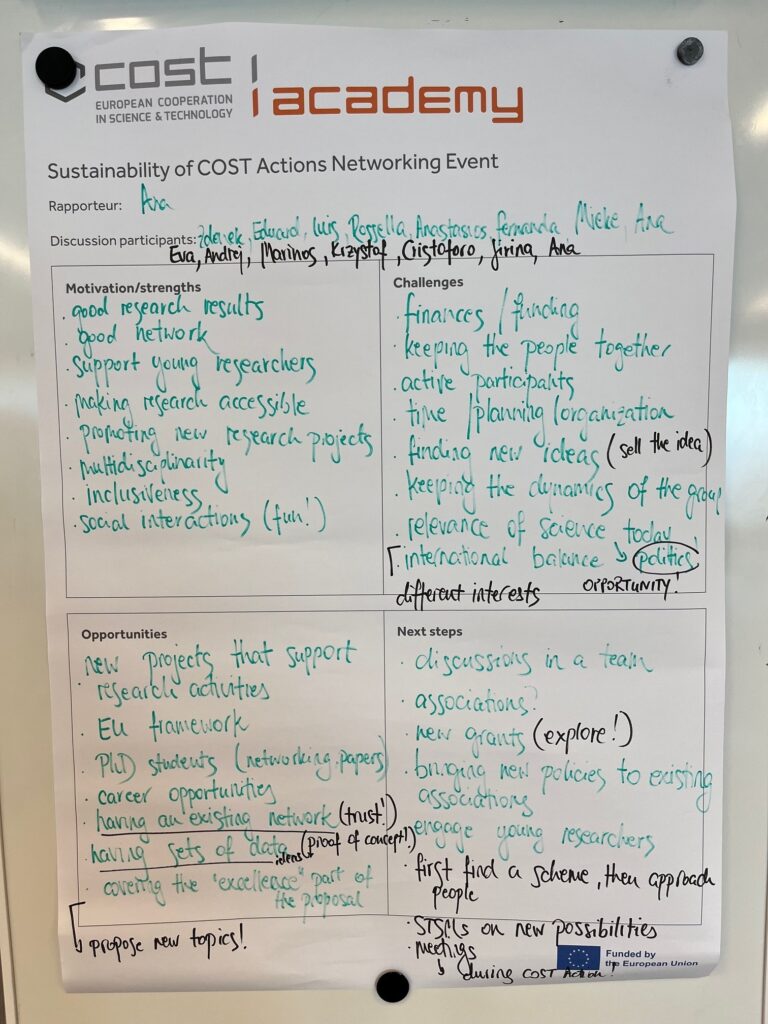
Discussion brainstorm chart at COST Academy - Sustainability of COST Actions Networking Event

The event also featured a World Café format, where participants engaged in in-depth discussions, identifying the strengths, opportunities, and challenges of COST Actions. A key takeaway was the emphasis on three essential elements for sustaining collaborative networks: establishing trust among researchers, fostering innovative ideas, and ensuring that these ideas successfully pass the proof-of-concept stage before being developed into project proposals. These factors are critical for the longevity and effectiveness of collaborative efforts.

For more impressions, follow MARGISTAR on Instagram

Keep In Touch

Join our newsletter for the latest project news and collaboration opportunities.

About MARGISTAR & How To Join

The MARGISTAR forum reflects collaboratively on natural, environmental, social, and economic inter-relationships and interactions in mountainous areas, and identifies a range of environmental, social, economic, and political challenges. It enables innovation by co-designing pathways for the transformation of marginalised mountainous areas towards their green, digital and healthy futures.

To join MARGISTAR, read the instructions here and get in touch!

Related articles

Pinching policymakers: Notes from a MARGISTAR Training School

Simo Sarkki (Natural Resources Institute Finland (LUKE), Finland), Renata Pacheco (IRTA, Sustainability in Biosystems, Spain), Irene Christoforidi (Department...

MARGISTAR Opens 5th Call for Short-Term Scientific Mission (STSM) Grant Applications

MARGISTAR has launched its fifth call for Short-Term Scientific Missions (STSMs) for mobilities occurring between June 15 and August 30, 2026. All applications must be submitted before May 30 and all activities must occur before August 30, 2026.

Call for Pitches: Pinching Policy-Makers & Green Diplomacy

The MARGISTAR COST Action invites its members to contribute to a high-level policy event in Brussels, designed to strengthen the interface between science, policy and practice in the context of marginal regions, ecosystem restoration and climate action.

A Bittersweet Harvest: Marginalisation and Survival in the Axarquía

The Axarquía region of Málaga is one of contradictions. To the tourist, it is a rugged viticulture paradise. To the local farmer, it is a demanding landscape that often asks for more than it gives back. Behind the world-renowned Muscat of Alexandria raisin lies a story of a community fighting to remain rooted in the land while the globalised world moves on.